
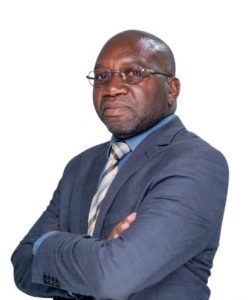
ASSISTANT DEAN
Phanuel Chuka Hakwendenda
Mr. Phanuel Hakwendenda is a lecturer and researcher in the Department of Geography, Environment and Climate Change (GECC) and currently the Assistant Dean in the School of Agriculture and Environmental Sciences at Mukuba University. Mr. Hakwendenda worked on a project on the effects of the 1992 drought on peasant (small-scale) farmers: case-studying Mumbwa district. He also worked on the project on the interface between the evolving urban land use and the planning of Solwezi urban at the University of Zambia. He is working on a project on climate change resilience through adaptation in ecologically fragile Copperbelt urban mining communities of Mufulira district.
Over the past 30 years, Mr. Hakwendenda has been actively involved in teaching, lecturing, research, and community service with various learning institutions and communities. He served as Head of Department at Solwezi Technical High School (1999-2010) and later as a Senior Lecturer at Solwezi College of Education—SOCE (2010-2020), on a full-time basis. He also served as a lecturer and residential officer at Zambian College of Open Learning—ZAMCOL (1998-2018) and as a regional research supervisor at Zambian Open University—ZAOU (2013-2018) on a part-time basis. He coordinated research and continuing professional development (CPD) activities at Solwezi College of Education and also held several other portfolios, such as School Experience Coordinator, Boarding Master, and Assistant Coordinator—Open and Distance Learning (ODL).
Mr. Phanuel Hakwendenda is a lecturer and researcher in the Department of Geography, Environment and Climate Change (GECC) and currently the Assistant Dean in the School of Agriculture and Environmental Sciences at Mukuba University. He holds a Master of Science (M.Sc.) in geography from University of Zambia with a bias towards urban studies and planning. Among the subjects Mr. Hakwendenda lectures in are human and economic geography, population and environment, climatology and meteorology, food security and climate change, and climate change and disaster management. He is currently undertaking a PhD study at the University of Zambia to investigate current research and practice in climate change resilience and adaptation in mining communities of Mufulira district in the Copperbelt province. He’s particularly interested in exploring factors that enhance resilience and adaptive capacity of ecologically fragile urban mining communities.
With more than 10 publications in various subjects of a multidisciplinary nature, Mr. Hakwendenda has proven transdisciplinary expertise in the areas of geographical sciences, urban studies and planning, population studies, environmental and climate sciences, and education. He participated in the development of the 2014 Zambia Primary Teachers’ Diploma syllabuses for Colleges of Education as a co-author of the Social Studies syllabus. He also participated in the development of the 2019 School Experience Toolkit organized by The Open University of the United Kingdom, in collaboration with the Ministry of General Education, to support School Experience Supervisors in Zambia.
Mr. Hakwendenda has also developed various educational materials for students in schools, colleges of education, and universities and has participated in program development for undergraduate and postgraduate students at Mukuba University. His work focuses on geographical/earth sciences, urban planning and population studies, environmental and climate change sciences, and education. He is a member of the Copperbelt Provincial Climate Change Steering Committee. He is also a member of the Education for Sustainable Development (ESD) Change Project at Mukuba University.
Mr. Phanuel Chuka Hakwendenda is an accomplished academic, researcher, and education administrator with over two decades of progressive experience in teaching, research, curriculum development, and institutional leadership. His professional journey reflects a strong commitment to academic excellence, capacity building, and advancing knowledge in geography, climate change, and environmental studies.
Currently, Mr. Hakwendenda serves as Lecturer and Researcher in the Department of Geography, Environment and Climate Change (since 2020) and as Assistant Dean in the School of Agriculture and Environmental Sciences (since 2025) at Mukuba University where he provides strategic and administrative leadership in ensuring quality teaching and learning and in helping coordinate school activities. He lectures both regular and distance students in key courses such as Human Geography, Climatology & Meteorology, Population & Environment, and Food Security & Climate Change. In addition, he actively contributes to curriculum development at both undergraduate and postgraduate levels and design learning modules tailored to diverse learning modes. His role also extends to research supervision and academic mentorship, fostering critical thinking and scholarly growth among students.
Alongside his full-time role, Mr. Hakwendenda has been a Part-Time Regional Research Supervisor at the Zambian Open University since 2013, where he guided undergraduate students through research design, implementation, and evaluation across various disciplines. Previously, he worked as a Senior Lecturer at Solwezi College of Education (2010–2020), where he taught geography and social sciences, developed instructional materials, and supervised teaching practice. During this period, he also held key leadership roles as Coordinator in Research and Continuing Professional Development (CPD) and School Experience, where he successfully coordinated institutional research activities, professional development programs, and student teaching placements respectively.
Mr. Hakwendenda’s experience further includes serving as a Part-Time Lecturer at Copperbelt University (2017–2020), where he taught communication skills to diploma and degree students, as well as a long-standing role as a Part-Time Lecturer at the Zambian College of Open Learning (1998–2018), where he lectured, supervised research, and supported distance education programs. Earlier in his career, he worked as Head of Department at Solwezi Technical High School (1999–2010), where he demonstrated strong leadership in managing staff, mobilizing resources, and overseeing academic planning and delivery.
In addition to teaching and administration, Mr. Hakwendenda is actively engaged in research and community service. He is a member of the Copperbelt Provincial Climate Change Committee and has contributed to numerous research projects, policy discussions, and community-based studies focusing on climate change, urban development, and education systems. His research output includes books, peer-reviewed journal articles, and book chapters addressing critical issues in environmental management, climate resilience, and education.
Mr. Hakwendenda has also played a significant role in academic program development, contributing to the design of undergraduate and postgraduate programs in environment and climate change, as well as national teacher education curricula. His involvement in professional workshops and training programs reflects his dedication to continuous learning and innovation in teaching and research. Throughout his career, he has supervised numerous student research projects and mentored emerging scholars, many of whom have successfully completed their academic programs. His work has been recognized through awards such as the World Labour Day Award (2025) and the Best Performing Teacher Award (2014).
Overall, Mr. Hakwendenda’s experience is grounded in a passion for teaching, research excellence, and institutional development, with a strong focus on addressing real-world challenges through education, particularly in the fields of climate change and sustainable development.
1. Samukonga, G., Kalezhi, J., Ochieng, R.M., Rekha, R. & Hakwendenda, P.C. (2026). Advancing Climate-resilient Energy Transitions: A Systematic Review of Mini-grid Design and Implementation. Journal of Energy Research and Reviews, 18(3),37–50. https://doi.org/10.9734/jenrr/2026/v18i3500
2. Hakwendenda, P.C., Musonda, J. & Handavu, F. (2026). The Role of Local Ecological Knowledge in Climate Change Adaptation among Smallholder Farmers in Mbereshi Village of Mwansabombwe District: A Case Study. International Journal of Environment and Climate Change, 16(1), 602–622. https://doi.org/10.9734/ijecc/2026/v16i15258
3. Hakwendenda, P.C. (2025). Effects of urban land-use policies on urban services structure in Africa: A review of current research. Journal of Geography, Environment and Earth Science International, 29(4):192-208.
https://doi.org/10.9734/jgeesi/2025/v29i4886
4. Hakwendenda, P.C. (2025). Current research and policy on urban land use and services structure in Africa: A systematic review. A preprint. MDPI.
https://doi.org/10.20944/preprints202504.0303.v2
5. Hakwendenda, P.C. (2022). Climate change resilience and adaptation strategies in ecologically fragile urban mining communities: A review of existing research and practice. International Journal of Environment and Climate Change, vol. 12(10): 38-73.
https://doi.org/10.9734/IJECC/2022/v12i1030771
6. Hakwendenda, P.C. (2021). Environment and climate change needs assessment study for Mukuba University: A document review. International Journal of Multidisciplinary Research & Development, vol. 8(10): 30-34. (Online ISSN: 2349-4182, Print ISSN: 2349-5979).
7. Hakwendenda, P.C. (2021). The interface between the evolving urban land use and the planning of Solwezi urban in Zambia. International Journal of Advanced Scientific Research, vol. 6(5): 18-27. (ISSN: 2456-0421).
8. Hakwendenda, P.C. (2021). Reflections of students on their preparedness to sit for end-of-year examinations at Solwezi College of Education in Zambia. International Journal of Multidisciplinary Research & Development, vol. 8(10): 12-19. (Online ISSN: 2349-4182, Print ISSN: 2349-5979).
9. Hakwendenda, P.C. & Njobvu, M. (2019). Student mentoring during school experience: Perceptions of mentors and student-teachers in selected primary schools of Solwezi and Mufumbwe districts in Zambia. International Journal of Multidisciplinary Research & Development, vol. 6(3): 166-175. (Online ISSN: 2349-4182, Print ISSN: 2349-5979).